The Persuasive
Voice-of-Customer
Framework
42 Questions | 8 Pages | Priceless Answers
Every B2B SaaS company says they're customer-centric.
Far fewer actually talk to their customers.
And even fewer ask the right questions.
That's a missed opportunity.
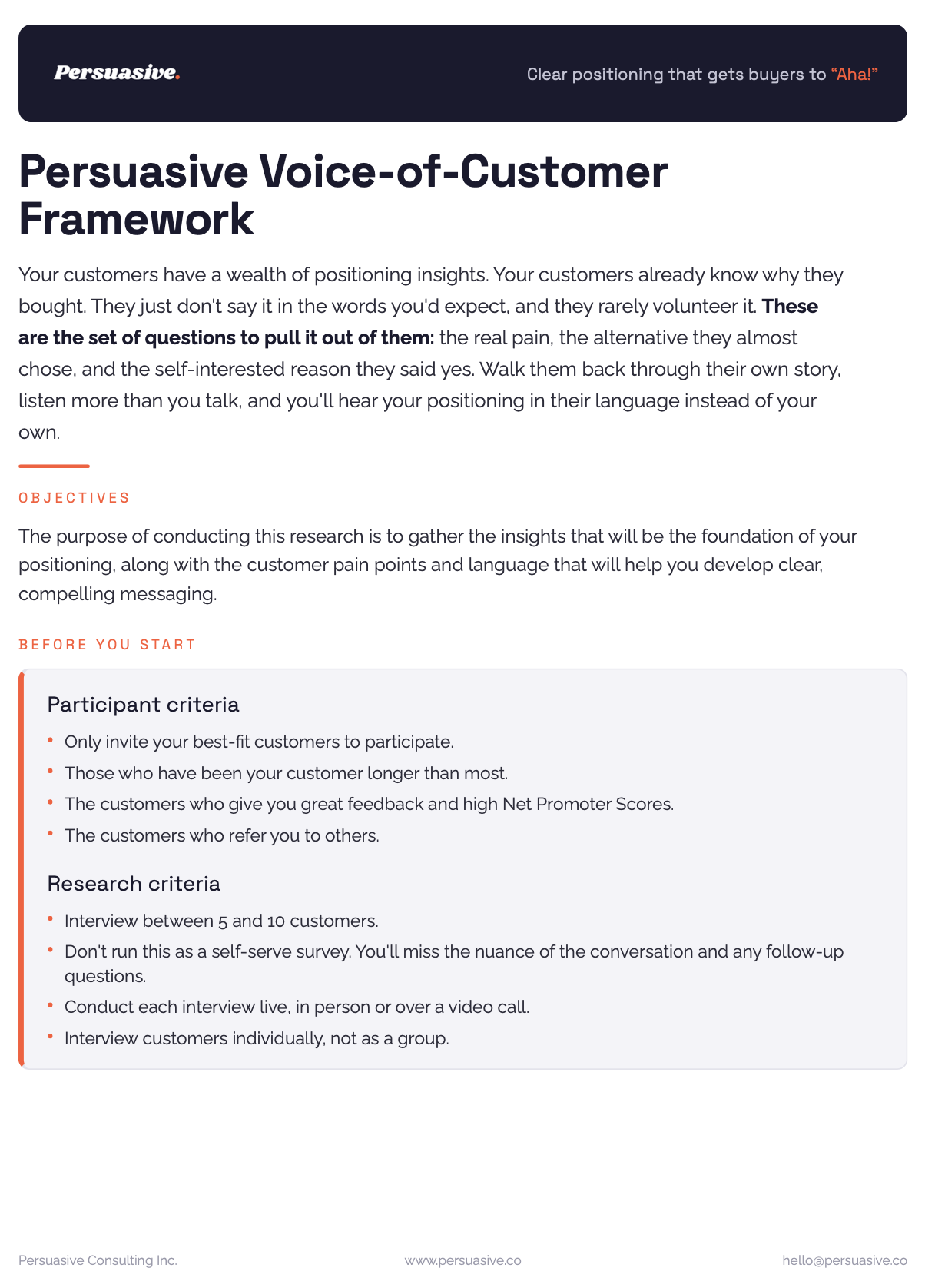
Your customers are sitting on a wealth of positioning insights. They already know why they bought. They just don't say it in the words you'd expect, and they rarely volunteer it. Your job is to ask the right questions, then listen.
The Persuasive Voice-of-Customer Framework is a structured customer interview guide that helps uncover the insights that become the foundation of your positioning and messaging.
Why customer interviews matter
Positioning isn't something you invent in a boardroom. It’s developed in a workshop with key stakeholders, informed by data and research.
It's something you discover by performing competitor research and by talking to the people who chose your product.
The best customer interviews reveal:
The real pain point your product solved.
The event that pushed them to finally look for a solution.
What they were doing before they found you.
The alternatives they considered.
Why they ultimately chose you.
How your product changed their work and their life.
The exact words they naturally use to describe your product.
Those insights give you the raw material you need to develop your positioning strategy.
The objective of customer interviews
The purpose of this research is simple:
Gather the insights that become the foundation of your positioning, along with the customer pain points and language that help you develop clear, compelling messaging.
Who should you interview?
Not every customer belongs in your research.
For the best results, interview customers who closely match your ideal customer profile.
Specifically, look for customers who:
Have been customers longer than most.
Consistently give you positive feedback.
Have high Net Promoter Scores.
Refer your product to others.
Aim to interview between 5 and 10 customers.
Conduct every interview live, either in person or over a video call. Don't send a survey. The best insights come from follow-up questions and unexpected conversations that surveys simply can't capture. Interview customers one-on-one, not in groups.
The Persuasive Voice-of-Customer Framework
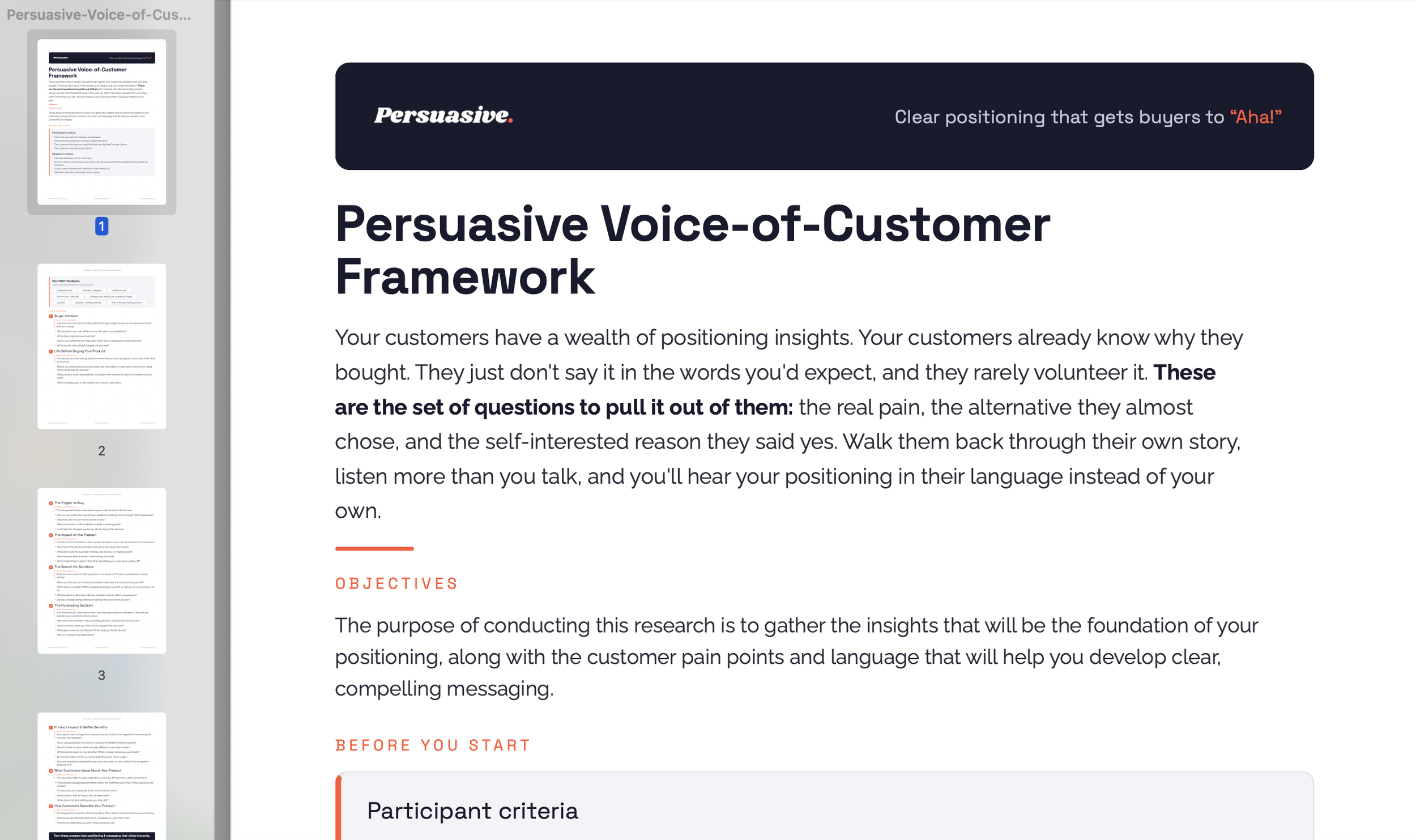
The Persuasive Voice-of-Customer Framework is organized into nine interview sections. Each section uncovers a different piece of the positioning puzzle.
Start With The Basics
Capture who you're talking to before you dig in:
Company name
Industry
Job title & role
Seniority
Company size (headcount or revenue stage)
Location
Decision-making authority
Role in the purchasing process
1. Buyer Context
What this reveals
How their work runs, how their performance is measured, and where your product fits into their day-to-day responsibilities.
Questions
Tell me about your role. What are you ultimately accountable for?
What does a typical week look like?
How is your performance measured? What does a really good month look like?
What are the most stressful aspects of your role?
2. Life Before Buying Your Product
What this reveals
The real pain you were solving, along with the workarounds, spreadsheets, tools, and manual processes customers relied on before they found your solution.
Questions
Before you started using our product, describe the problem or pain point and how you dealt with it. What was the process?
What products, tools, spreadsheets, or people were involved?
What frustrated you?
What felt harder than it should have been?
3. The Trigger to Buy
What this reveals
The change that turned a tolerated annoyance into, "We have to fix this now."
Questions
Can you remember the moment you realized something had to change? What happened?
Why then, and not six months earlier or later?
Was it one event, or did frustration build to a breaking point?
If nothing had changed, would you still be doing it the old way?
4. The Impact of the Problem
What this reveals
The real cost of the problem in time, money, and stress, so you can understand the true impact on both the business and the individual.
Questions
How much time did this problem cost you or your team each week?
What did it cost the business in money, lost revenue, or wasted spend?
Who else was affected when it went wrong, and how?
What made fixing it urgent rather than something you could keep putting off?
5. The Search for Solutions
What this reveals
What you were really competing against. That might have been another vendor, an internal solution, a spreadsheet, an agency, AI, or simply doing nothing.
Questions
When you first set out to solve the problem, what was the very first thing you did?
What did you consider? Other products, building it yourself, an agency, AI, or carrying on as-is?
What alternative did you seriously consider?
Did you consider doing nothing or staying with your current solution?
6. The Purchasing Decision
What this reveals
Who was involved, what concerns came up during the buying process, and what ultimately gave everyone confidence to move forward.
Questions
Who else was involved in the purchasing decision, and who had the final say?
What concerns came up?
What almost stopped the purchase?
What gave everyone confidence?
Why us instead of the alternatives?
7. Product Impact & Selfish Benefits
What this reveals
The business outcomes your product created, along with the personal benefits customers experienced in their own work, confidence, reputation, and peace of mind.
Questions
Since using our product, how has the company benefited?
What's actually different in your day or week?
What became easier or less stressful?
What's in it for you personally?
Has your standing changed with your boss, your team, or your clients?
8. What Customers Value About Your Product
What this reveals
The value customers would fight to keep and the capabilities they rely on most.
Questions
If the product disappeared tomorrow, what's the first thing you'd miss?
What would you do instead?
If I took away one capability, which would hurt the most?
What feature do you rely on every week?
What does it do that nothing else you tried did?
9. How Customers Describe Your Product
What this reveals
The language customers naturally use to explain your product. These are often the words that become your best headlines, messaging, and website copy.
Questions
How would you describe our product to a colleague in your exact role?
If someone asked why you use it, what would you say?
Download the complete framework
The questions above are the exact framework I use to uncover positioning insights for B2B SaaS companies.
If you're planning your own positioning research, download the Persuasive Voice-of-Customer Framework to get the complete interview guide in a printable PDF format.
Fill out the form below to get a copy so you can use it in your own customer interviews.